The Whipple Expedition
An Important Event for Oklahoma Geology
The discovery of gold in California at Sutter’s Mill in 1848 opened the door for a mass immigration of individuals and families to settle in the western areas of the country. It soon became apparent for the need of a coast-to-coast rail system to quickly move people and freight across the rapidly expanding United States.
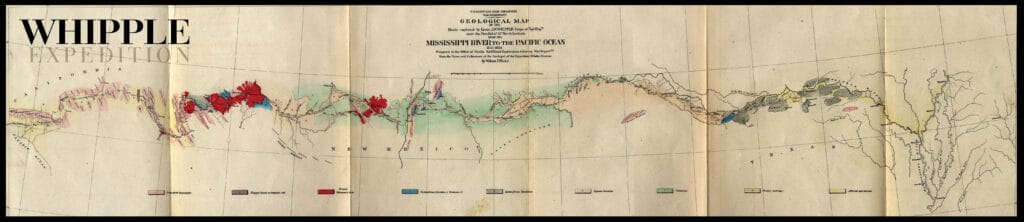
In March of 1853, the United States Congress authorized four separate land surveys of potential routes for a transcontinental railroad. Army Lt. Amiel W. Whipple was chosen to be in charge of the 35th Parallel Survey. Lt. Whipple was given the monumental task to study a southern route from Fort Smith, Arkansas, across the Indian Territories (which later became Oklahoma), across the Texas Panhandle, through New Mexico, across the Zuni areas of Arizona, and finally ending at Pueblo de los Angeles.
The importance of this expedition was that among the seventy men chosen to conduct the survey were astronomers, naturalists, artists, botanists, and one geologist by the name of Jules Marcou. Because of his involvement with the survey members, Marcou is now credited as being the first true geologist to have traveled and recorded geological events through the Oklahoma Indian Territories.
Jules Marcou was born in Salins, in the department of Jura, France and educated at Besancon and at the college Saint Louis, Paris. In 1847, he traveled to North America as a geologist for the Jardin des Plantes and was charged with studying the United States and the English possessions in North America. In 1853, he entered the service of the United States government and was chosen to be the sole geologist for the Whipple Expedition.
The Whipple Expedition began in Fort Smith, Arkansas on July 14, 1853, first crossing the Poteau River into Oklahoma. At the start of the journey, Marcou made note of the numerous coal deposit outcrops of Eastern Oklahoma which would be an important resource for the railroads to power the train engines.
Proceeding on west, the expedition followed a route south and parallel to the Canadian River and through the valley of the Washita. Per Marcou, the route for the potential railroad was sufficiently supplied with sandstone suitable for the bridge-building required to exist in the soft Triassic formations for the western portions of the proposed route.
By August 10th, the Whipple Expedition had set up camp a few miles east of Shawnee Town, and by late August, the group had reached Camp Arbuckle located in Garvin County along Wild Horse Creek. This camp was also known as Beaversville, aptly named for the Delaware Indian Chief, Black Beaver. Here they spent the next four days resting and making repairs for the long journey to the Pacific Ocean.
Continuing westward through present day Caddo County, the expedition encountered a landmark which was known as “Rock Mary.” This large, red sandstone outcrop is located about five miles west of Hinton, Oklahoma and in 1849 was named after the 17-year-old niece of Dr. John R. Conway, a prominent physician and surveyor who emigrated to California.
Marcou noted that, “the ease with which the red sandstone decays under the influence of the atmosphere, is the cause of the phenomena so frequent in these regions, of immense separate blocks, which assume the form of gigantic cones or pillars of architectural ruins, etc. The environs of Rock Mary on the right bank of the Canadian, offer many examples of this.”
Marcou made reference to the vast, immeasurable accumulations of gypsum beds irregularly intersected with veins of selenite, dolomite, magnesium limestone and beds of rock salt or saline clay between the layers of gypsum.
On September 6, 1853, the Whipple Expedition crossed into the Texas Panhandle along the 100th Meridian that denoted the western border of the Indian Territory. Thus, after 54 days, the first crossing of Oklahoma by a noted geologist was completed by Jules Marcou.
After completing the Whipple Expedition on March 21, 1854 (a trek of 203 days), Marcou returned to Europe where he became a professor of geology and paleontology at the Polytechnic School of Zurich. In 1861, he would publish a Geological Map of the World before returning to America where he founded the Museum of Comparative Zoology in Cambridge, Massachusetts. Marcou passed away in 1898, nine years before the statehood of Oklahoma, but through his travels, forever leaving a legacy of its geological history.
Written by Terry L. Hollrah